AI Under the Hood – Feb – Week 3
How AI Music Generation Systems Are Quietly Becoming Production-Grade AI music has existed for years, but for a long time it lived on the edges.Interesting

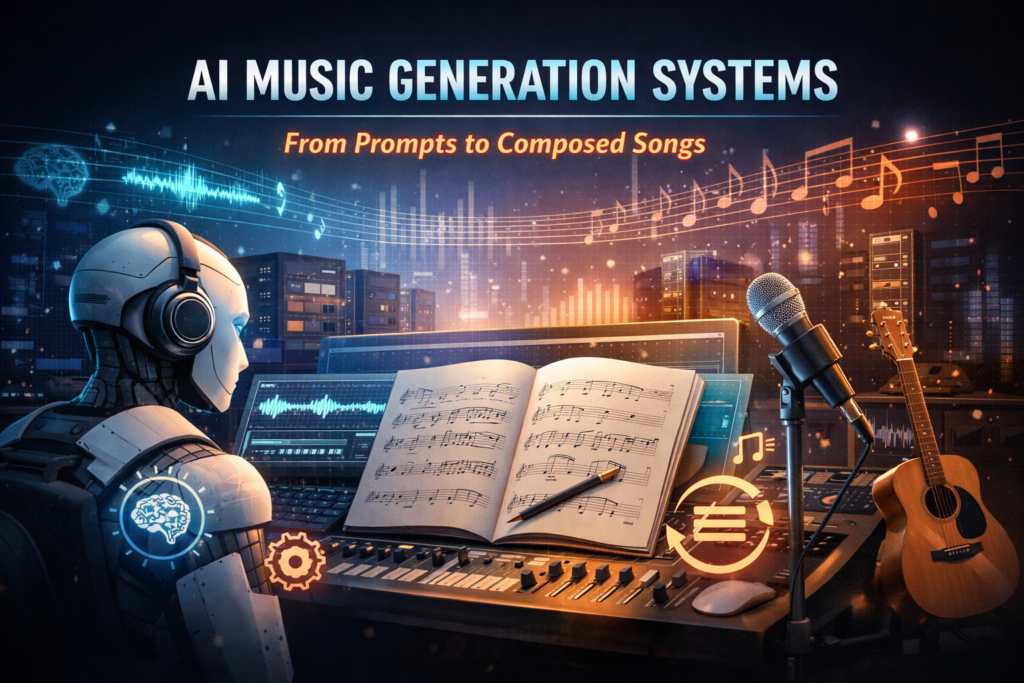
AI music has existed for years, but for a long time it lived on the edges.
Interesting demos. Novel experiments. Something you played with, not something you built with.
That line is now starting to blur.
What’s changing is not just the quality of the music, but the structure behind how these systems generate it. For founders, creators, and technical leaders, this shift matters because music is no longer just being “generated.” It’s being planned, edited, restructured, and reused inside coherent workflows.
You don’t need to understand signal processing or model architectures to grasp what’s happening here. You just need to understand one thing: AI music generation systems are moving from novelty toward infrastructure.
The recent advances around Suno AI make this shift clearer than most announcements.
At a high level, four changes stand out.
First, music generation is no longer a single-shot output. Systems are learning to reason about structure, pacing, and transitions before sound is produced.
Second, language is becoming central. These models don’t just “sing.” They interpret intent, mood, genre, and narrative from text and turn that into musical decisions.
Third, editing has moved upstream. Instead of exporting a song and fixing it elsewhere, creators can now alter sections, lyrics, or instrumentation inside the generation system itself.
Finally, the gap between closed platforms and open, locally run systems is shrinking. Quality is no longer exclusive to cloud-only tools.
Together, these shifts signal a transition from music generators to music systems.
Earlier AI music tools behaved like slot machines. You entered a prompt, waited, and accepted whatever came out.
What’s changing is the presence of a planning layer.
Modern AI music generation systems can decide things like:
How long a song should be
Where verses and choruses belong
When energy should rise or fall
How vocals and instrumentation interact
This planning happens before audio is rendered, not after. That matters because structure is what separates a loop from a song.
In practice, this means users are no longer fighting randomness. They’re guiding it.
For product teams and creators, this reduces iteration cost. You don’t regenerate endlessly hoping for something usable. You refine direction and let the system handle execution.
One of the clearest signals of maturity is micro-editing.
Instead of regenerating an entire track to fix a lyric, melody, or moment, newer systems allow you to isolate a few seconds and change only that segment. The rest of the song remains intact.
This is a quiet but important shift.
It means AI-generated music can now behave more like recorded music. You revise instead of restart. You iterate instead of discard.
From a business perspective, this opens doors for:
Faster creative cycles
Versioned content workflows
Personalized variations without full regeneration
Music stops being disposable output and starts becoming editable media.
Traditional “AI covers” often raise obvious concerns. Many simply mimic an existing song too closely, reproducing melody and structure with superficial changes.
Newer approaches take a different path.
Instead of copying, they reinterpret. The system keeps the broad structure but rewrites melody, instrumentation, and mood to match a new style. The result feels inspired, not duplicated.
This distinction matters.
It moves AI music away from imitation and closer to transformation. For platforms, this reduces risk. For creators, it increases creative freedom.
One of the most overlooked aspects of this shift is where these systems can run.
High-quality AI music generation is no longer limited to powerful cloud platforms. Some systems now operate efficiently on consumer hardware, even without a GPU.
This changes who can experiment and who can deploy.
For enterprises, it enables:
On-premise music generation
Data privacy and control
Custom workflows without platform lock-in
For developers, it means AI music can become a component, not a dependency.
Despite the progress, limitations remain.
Certain genres, especially orchestral music, still struggle with realism. Complex physical interactions between instruments are hard to simulate convincingly.
High-speed passages can introduce artifacts. Emotional nuance, while improving, is not yet consistent across outputs.
These aren’t failures. They’re boundaries.
Understanding them is important because it keeps expectations grounded. AI music systems are advancing quickly, but they are not universal replacements for human musicians.
Yet.
The most important signal is not sound quality.
It’s control.
As AI music generation systems gain better planning, editing, and structure, they stop being toys and start becoming tools. Tools fit into workflows. Toys do not.
At Nerobyte, we don’t treat these developments as hype cycles. We treat them as infrastructure signals.
The question is no longer whether AI can make music.
The question is how music will be designed, edited, and distributed when intelligence becomes part of the production layer itself.
That’s the shift worth watching.