AI Under the Hood – Feb – Week 3
How AI Music Generation Systems Are Quietly Becoming Production-Grade AI music has existed for years, but for a long time it lived on the edges.Interesting

Edition: Feb 26 · Week 2
By Nerobyte Technologies
AI video has spent the last year producing impressive moments but unreliable results. Short clips looked convincing, but anything longer quickly revealed limitations. Characters drifted, motion broke down, and scenes felt accidental rather than designed.
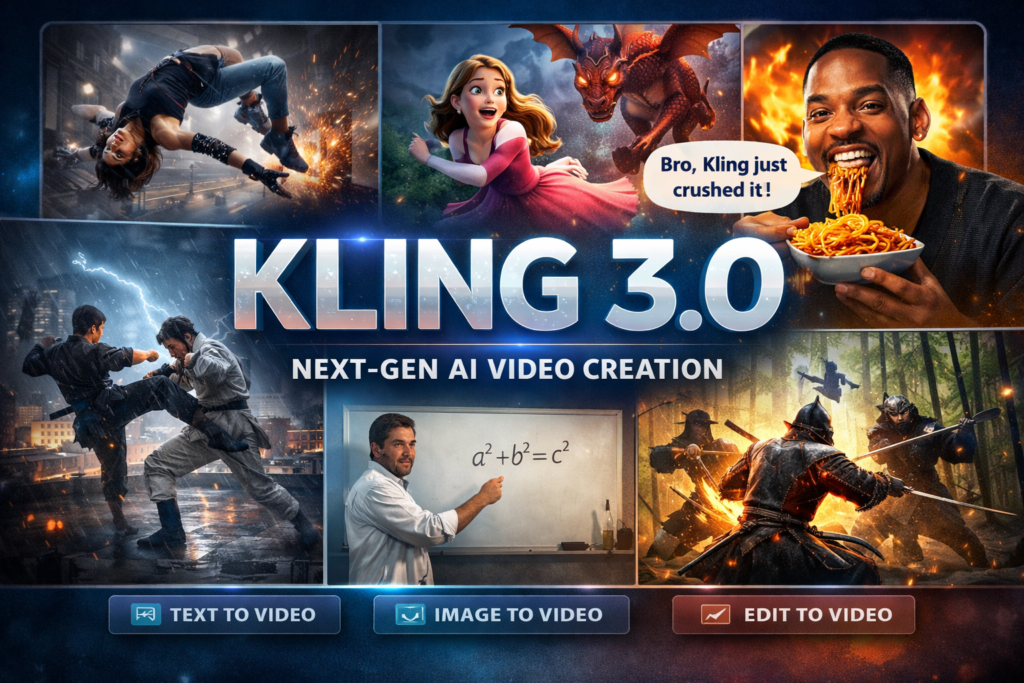
Kling 3.0 marks a meaningful shift in how AI video generation systems behave.
Not because it suddenly makes perfect video, but because it introduces structure. Kling 3.0 treats video less like a one-off visual trick and more like a system that understands sequencing, continuity, and control.
For beginners, this distinction matters. When AI video moves from isolated clips to coherent scenes, it stops being a novelty and starts becoming usable.
The most important change in Kling 3.0 is not higher resolution or sharper visuals. It is how video is constructed.
Kling 3.0 moves AI video generation systems away from single-shot outputs toward multi-shot, sequence-aware generation. Instead of producing one continuous clip and hoping it holds together, the system understands a video as a series of shots that belong to the same scene.
Alongside this core shift, Kling 3.0 introduces three supporting changes that matter for real use.
First, video consistency improves. Characters, clothing, and environments persist across shots instead of resetting between generations.
Second, Kling 3.0 treats video as multimodal by default, coordinating visuals, speech, lip sync, camera movement, and audio together.
Third, video becomes editable, not disposable. Existing video can be modified using natural language instead of regenerated from scratch.
Together, these changes move Kling 3.0 closer to a system than a demo.
Multi-shot generation is the most important capability introduced in Kling 3.0.
Earlier AI video generation systems treated video as a single continuous take. You described a scene, and the model attempted to animate it for a few seconds. There was no understanding of shots, pacing, or sequencing.
Kling 3.0 introduces explicit structure. Each shot can be defined independently: what happens, how long it lasts, and how the camera behaves. The system then stitches those shots together into one coherent sequence.
What makes this significant is not the presence of cuts. It is that Kling 3.0 understands all shots as part of the same story.
Characters remain visually consistent across shots. Environments do not reset. Motion flows forward instead of restarting. The result feels cinematic not because it looks dramatic, but because it follows the logic of video storytelling.
This is the difference between generating clips and constructing scenes.
Another key improvement in Kling 3.0 is control.
Instead of vague prompts, users can specify camera movement, emotional expression, pacing, and duration at the shot level. Zooms, orbits, handheld motion, and perspective shifts are executed reliably rather than guessed.
This changes how AI video generation systems are used.
Earlier systems rewarded experimentation and luck. Kling 3.0 shifts the balance toward direction. When structure is described clearly, the system follows it.
This is also why video consistency improves. Context creates constraints, and constraints reduce drift.
The output is still imperfect, especially in fast-moving scenes, but the failure mode has changed. Kling 3.0 is attempting coherence, not just spectacle.
Audio integration is another important signal.
Earlier AI video systems struggled with speech. Lip sync was unreliable. Non-English languages were inconsistent. Audio often felt detached from visuals.
Kling 3.0 shows tighter coordination between spoken dialogue, facial movement, and timing. It can generate speech in multiple languages, follow accents, and keep lip movement reasonably aligned.
This matters because multimodal coordination is difficult. When audio and visuals stay synchronized, it indicates that the system understands them as parts of the same event.
For global content, narrative video, and interactive experiences, this capability is foundational rather than cosmetic.
A major shift in Kling 3.0 is how it treats existing video.
Instead of forcing users to regenerate entire scenes, Kling 3.0 allows video to be edited using natural language. Clothing can change. Environments can shift. Lighting and mood can be adjusted.
This reframes AI video generation systems as tools for iteration, not just creation.
It mirrors real video workflows. Editors refine and revise rather than starting over. For businesses and creators, this reduces friction and cost. For AI video itself, it signals maturity.
Kling 3.0 does not eliminate the challenges of AI video.
High-action scenes still expose weaknesses. Fast motion can blur details. Anatomy can distort. Faces can lose consistency under movement.
What has changed is the baseline.
Compared to earlier systems, motion is more physically plausible. Limbs generally behave as expected. Actions follow intent. Errors are smaller and less disruptive.
Realism improves incrementally. Kling 3.0 does not solve physics, but it meaningfully narrows the gap.
Beyond visuals, Kling 3.0 shows improved world understanding.
It can interpret cultural references, emotional intent, and contextual behavior. It understands not just what something looks like, but how it should behave within a situation.
This is critical for storytelling. When an AI video generation system understands context, it produces behavior that aligns with expectations instead of merely copying appearances.
Kling 3.0 is best understood as a signal rather than a finish line.
It shows that AI video generation systems are moving:
From isolated clips to structured sequences
From novelty-driven demos to controllable workflows
From visual output to multimodal coordination
The most important improvement is not that Kling 3.0 looks better. It is that it behaves more predictably.
For creators, this enables longer narratives.
For businesses, it reduces production friction.
For the industry, it marks a step toward trust built on consistency rather than surprise.
Kling 3.0 does not represent the final form of AI video. It represents a direction.
The key signal is alignment: between shots, between audio and visuals, and between instruction and output.
As AI video generation systems continue to evolve, the most valuable systems will not be the flashiest. They will be the ones that are stable, controllable, and understandable.
At Nerobyte, we read releases like Kling 3.0 not as isolated feature updates, but as indicators of where AI is becoming reliable enough to integrate into real workflows.
The story is no longer about what AI video can generate.
It is about what it can sustain.